Shardblades
The Way of KingsShardblades are extraordinary weapons whose history reaches back to the Knights Radiant and whose use exposes the moral distance between fighting supernatural enemies and killing ordinary people. They can cut stone and steel, sever a living person’s soul rather than ordinary flesh, and appear in a wielder’s hand after the tenth heartbeat. Their magnificence makes them objects of awe, but their presence in human conflict also makes life frighteningly cheap.
Origin and Nature
According to legend, the first Shardblades were carried by the Knights Radiant in an age when humanity fought the Voidbringers, colossal enemies of rock and flame whose eyes burned with hatred and whose skin was hard as stone. Steel could not harm such foes, so the Blades represented something supernal: weapons made for battles beyond the capacity of ordinary arms. This origin gives them a sacred and nearly mythic status, while also linking them to the ancient struggle between humanity and the Voidbringers.
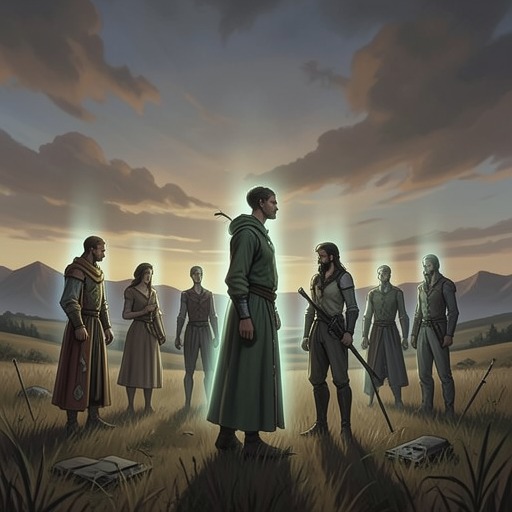
The Blades are described as unique and precious, with craftsmanship that exceeds even ordinary Shardblades. After a devastating battle, Kalak reaches a meeting place beneath a towering rock spire and finds seven magnificent swords driven point-first into the stone. Each is a masterwork, marked by flowing designs, glyphs, and patterns. He recognizes every one of them, and understands that the weapons would have vanished if their masters had died. The scene establishes that these Blades are not merely valuable equipment: their continued presence carries information about the survival of their wielders.
Summoning and Physical Form
A Shardblade does not remain continuously in the hand of its wielder. When Szeth waits through ten heartbeats, his Blade forms as though condensing from mist, with water beading along its metal length. His weapon is long and thin, edged on both sides, and smaller than most others. The delayed appearance makes possession a matter of timing as well as strength, and the repeated tenth-beat arrival gives the weapon an almost ritualized presence.
Dalinar’s Shardblade, Oathbringer, appears in the same manner when the tenth beat of his heart arrives. Six feet long from tip to hilt, slightly curved, a handspan wide, and shaped with wavelike serrations near the hilt, it would be unwieldy for a man without Shardplate. Its tip bends like a fisherman’s hook, and cold dew covers it when it materializes. Dalinar has carried Oathbringer since his youth, bonding with it when he was twenty Weepings old, and experiences it as part of himself, sensing energy racing along its blade as if the weapon were eager.
Elhokar’s Shardblade, Sunraiser, provides another distinct design. It is long and thin, fitted with a large crossguard, and etched along its sides with the ten fundamental glyphs. The contrast among Sunraiser, Oathbringer, Szeth’s narrower weapon, and the seven swords at the spire shows that Shardblades share a supernatural category without becoming interchangeable objects. Each has an individual shape, history, and relationship to its bearer.
How the Blade Kills
Shardblades behave differently toward living and inanimate matter. Szeth’s weapon passes through stone and cuts a line across the floor, yet when it touches living skin the metal fuzzes rather than slicing through it. Passing through a guard’s neck without leaving a conventional wound, it causes the man’s eyes to smoke and burn until they blacken and shrivel. The victim collapses dead because the Blade has severed the soul itself rather than simply cut the body.
The same principle produces different degrees of destruction depending on the point of contact. A strike through the spine kills outright, while a cut through the core of a limb kills that limb, leaving the soldier unable to feel or use it. The weapon therefore bypasses ordinary assumptions about armor, flesh, and injury. Its violence is not merely sharper physical force; it operates according to a separate metaphysics in which the soul is a vulnerable target.
Human Use and Moral Consequences
Szeth’s assault demonstrates the inversion of the Blade’s legendary purpose. Weapons created to fight enormous supernatural horrors are turned against common soldiers in a king’s hall. The guards panic because they are confronted by a Shardbearer, while Szeth moves across walls and ceilings through Lashings, cutting down men who are disoriented by the impossible angle of the attack. His elegant swings leave cinder-eyed corpses around him, and the weapon’s grandeur becomes inseparable from mass death.
That contrast is the central moral consequence of the Shardblade. In legends, it is the necessary answer to enemies whose bodies make steel useless; in a human hallway, the same weapon transforms individual soldiers into expendable objects. The Blade’s extraordinary power does not preserve the value of life. Instead, when directed at ordinary people, it makes killing appear effortless and exposes how sacred origins can be repurposed for profane violence.
Dalinar’s experience reveals the opposite emotional register. With Shardplate and Oathbringer, he feels that a man never truly knows life until charging into battle with Plate and Blade. The sensation joins exhilaration, identity, and martial purpose, while the hunt involving Elhokar and Sunraiser also shows the practical danger of such power: Dalinar is more concerned with soldiers and attendants than with the monster itself, considering whether the group should withdraw and let it feed on chulls and hogs. Thus the Shardblade can inspire communion with battle even as responsible judgment demands restraint.
Narrative Significance
Shardblades function simultaneously as weapons, relics, evidence, and ethical tests. At the spire, seven Blades silently reveal that their masters may still be alive; in Szeth’s hands, a Blade confirms the lethal capacity of a Truthless man forbidden to take only one life—his own; and in Dalinar’s hands, Oathbringer embodies a long personal bond that reaches back to his youth. The object therefore carries information about history and identity whenever it appears.
Its most important narrative tension lies between transcendence and brutality. The Shardblade is beautiful, unique, and associated with the Knights Radiant, yet its soul-severing edge can make human existence seem negligible. Every appearance asks what happens when an instrument designed for the defense of humanity is used within humanity’s own wars. The answer is not simply victory: the Blade’s power brings awe, tactical advantage, personal attachment, mutilation, and death, all within the same gleaming form.